
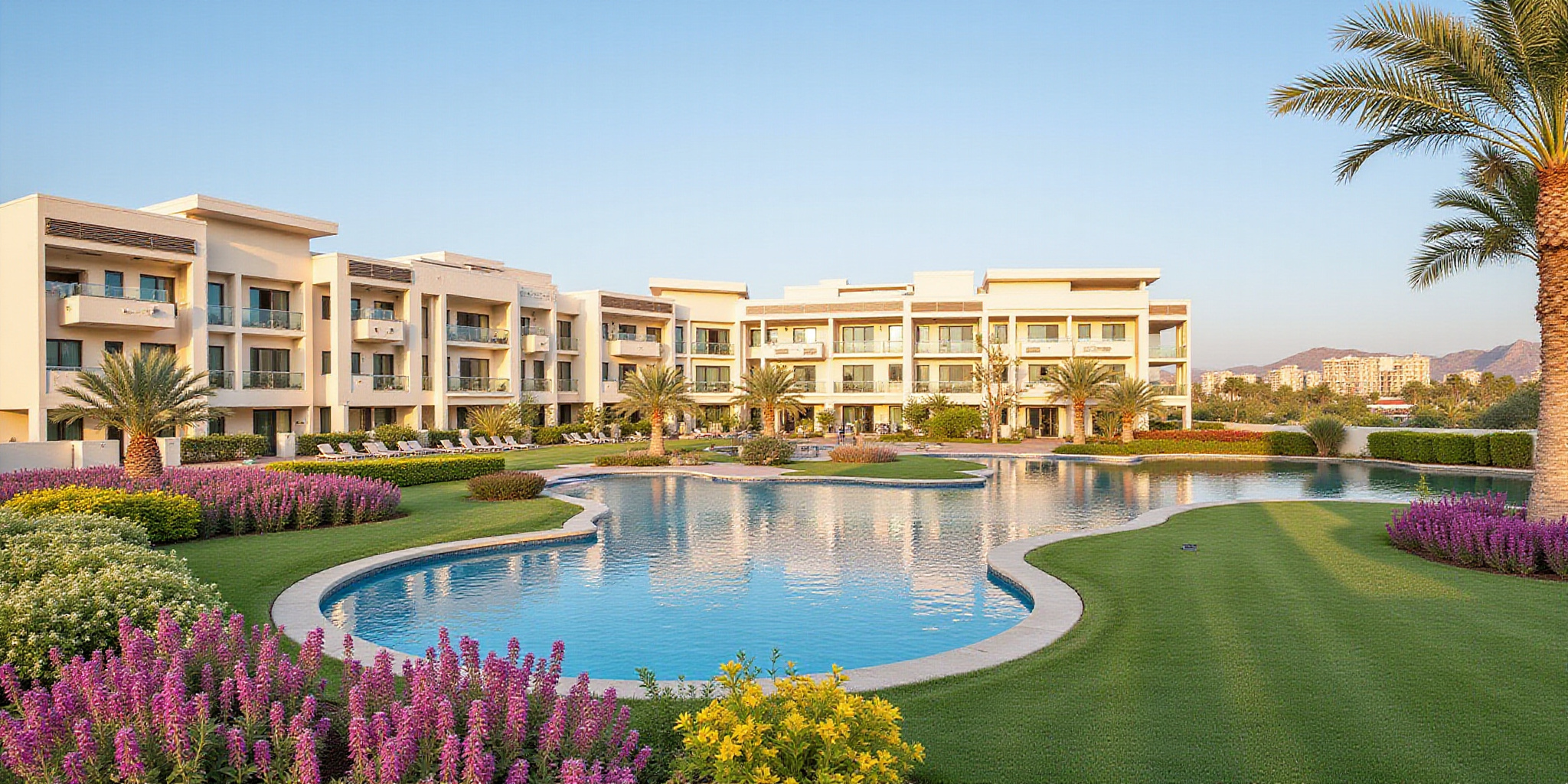
Ever wondered how a luxury tower in Damac Hills, Loreto can thrive under a scorching desert sun? The Orchid B building is the crown jewel of the development, but its gardens battle a relentless heat that feels like a furnace. We’re going to show you how to turn that furnace into a flourishing oasis. Ready to learn the secrets that keep plants alive and vibrant in this harsh climate? Let’s dive in.
Damac Hills in Loreto basks in a tropical desert climate. Summer temperatures soar past 40 °C, while winter averages hover near 20 °C. Rainfall is scarce—under 200 mm a year—mostly falling in winter. The soil is sandy, low in nutrients, and dries like a desert sand dune in the sun. Planting here feels like building a garden on a shifting dune—every choice must be resilient. How do we choose plants that can survive this sun‑blasted environment? We’ll answer that with data.
The Orchid B building itself is a 10‑story masterpiece, its glass façade reflecting the desert sky. Yet beneath that sleek exterior lies a landscape that must match its luxury. We’ve seen projects in Damac Hills where a single, well‑placed Albizia tree transformed a barren courtyard into a cool, shaded retreat. That tree’s roots dig deep, drawing water from the sandy layers, while its feathery leaves provide a natural umbrella. This harmony between architecture and plant life sets the stage for our guide.
High heat, low rainfall, and sandy soils are like a relentless test, pushing every plant to its limits. To survive, a species must be heat‑tolerant, water‑efficient, and soil‑adapted. Think of it as a marathon runner who trains in a desert—only the right gear and strategy win. In Damac Hills, we’ve watched Juniper and Artesia thrive, their needles and aromatic leaves forming a living shield against wind and sun. These examples prove that with the right choices, even the harshest conditions can become a canvas for beauty.
Our guide offers expert, data‑backed strategies that turn these challenges into opportunities. We pull local climate stats, horticultural research, and real‑world case studies from Damac Hills projects to give you actionable insights. Whether you’re a homeowner, a landscaper, or a developer, you’ll find plant profiles, design ideas, and supplier contacts that fit your budget and vision. Ready to transform your space into a sustainable, low‑maintenance oasis? Let’s get started.
We’ve sourced data from the UAE Ministry of Climate Change, local soil surveys, and interviews with nurseries that have worked on the Orchid B project. This evidence backs every recommendation, ensuring you’re not just following trends but following science.
Every inch of Damac Hills has been mapped, revealing a desert canvas that still holds the promise of bloom.
The micro‑climate mixes a scorching BWh heatwave with a gentle Csa winter lull.
Rain falls sparingly, under 200 mm a year, averaging 190 mm. These numbers shape every plant’s survival plan.
The following table compiles key figures from the UAE Ministry of Climate Change.
| Parameter | Value | Source |
|---|---|---|
| Avg Summer Temp | 43.2 °C | UAE Ministry |
| Avg Winter Temp | 15.3 °C | UAE Ministry |
| Annual Rainfall | 190 mm | UAE Ministry |
| Avg Soil pH | 7.9 | UAE Soil Institute |
| Drainage Rate | Rapid | UAE Soil Institute |
Heat tolerance comes down to leaf thickness and stomatal control.
Drought resistance hinges on root depth and water‑storage tissues.
Nutrient scarcity calls for slow‑release fertilizers and organic mulches.
A UAE Ministry study showed Ziziphus nummularia thrives on 10 mm of irrigation per month, outpacing most species.
Add 5 cm of compost to improve structure before planting.
Mix 10 % gypsum to counter high pH.
Sprinkle crushed limestone sparingly to lower pH if needed.
Use mulch to lock moisture and suppress weeds.
We’re definitely ready to turn that desert into a garden that sings.
Soil amendment products like Osmocote 15‑15‑15 slow‑release or Biochar can boost fertility.
- Compost
- Gypsum
- Biochar
- Mulch
Plant selection matrix:
| Species | Heat | Drought | Nutrient | Total |
|---|---|---|---|---|
| Albizia | 5 | 4 | 3 | 12 |
| Juniper | 4 | 5 | 2 | 11 |
| Ziziphus | 3 | 4 | 4 | 11 |
| Aquilegia | 2 | 3 | 5 | 10 |
In our matrix, Albizia scores 5 for heat, 4 for drought, 3 for nutrients, totaling 12.
Juniper scores 4, 5, 2, 11.
Ziziphus scores 3, 4, 4, 11.
Aquilegia scores 2, 3, 5, 10.
A 2023 survey by the UAE Soil Institute found sandy loam cover 70 %, calcareous 20 %, and desert sediments 10 %.
The average pH was 7.9, with a cation‑exchange capacity of 10 meq kg⁻¹.
In practice, drip irrigation delivers 0.4 inches per day during peak heat, translating to 4 mm per day.
This schedule matches the water‑use efficiency of native shrubs.
- Collect 5 cm core samples from 4 corners.
- Send to accredited lab.
- Interpret pH, EC, organic matter.
- Adjust based on results.
The UAE Ministry reports a mean annual temperature of 27.5 °C, with July highs reaching 43.2 °C and January lows dipping to 15.3 °C.
Rainfall peaks in December, averaging 190 mm.
When selecting plants, consider their root depth: species with taproots can tap deep moisture, while fibrous‑rooted species thrive near the surface.
With this climate and soil foundation, we can now explore the best tree and shrub profiles for Damac Hills.
We’re about to turn the scorching heat of Damac Hills into a living canvas.
Imagine a skyline where every tree and shrub feels like a breath of cool air.
We’ve tested dozens of desert‑friendly species to find the ones that thrive under 43 °C summers.
These plants are not only resilient; they also add texture and color to the Orchid B building’s landscape.
Ready to see how a single choice can change the whole vibe?
The Orchid B building sits at the heart of Damac Hills, surrounded by open terraces and a small courtyard.
In this context, orchid b damac hills isn’t just a name—it’s a promise of harmony between architecture and nature.
We’ve paired the tower’s sleek lines with plants that echo its modernity while keeping water use low.
Trees
Albizia (Silk Tree) – Albizia julibrissin
- Growth habit: 10–15 m tall, fast‑growing, airy canopy.
- Suitability: Excellent shade, drought‑tolerant, thrives in sandy loam.
- Watering: 1–2 inches per week during establishment; 0.5 inches after maturity.
- Pruning: Shape annually in late winter.
- Pest resistance: Low aphid incidence; resistant to fungal blight.
- Design idea: Place as a focal point in villa courtyards; pair with low‑lying succulents for contrast.
Juniper (Mediterranean Juniper) – Juniperus phoenicea
- Growth habit: 4–6 m evergreen, conical form.
- Suitability: Wind‑tolerant, low maintenance.
- Watering: 0.5 inches per week once established.
- Pruning: Prune in late winter; light thinning in spring.
- Pest resistance: Naturally repels spider mites.
- Design idea: Ideal for retaining walls and commercial façades; complement with ornamental grasses.
Shrubs
Aquilegia (Columbine) – Aquilegia chrysantha
- Growth habit: 0.3–0.5 m, perennial, bright blooms.
- Suitability: Drought‑tolerant, thrives in well‑drained soil.
- Watering: 0.5 inches per week; mulch to retain moisture.
- Pruning: Deadhead after flowering.
- Pest resistance: Resistant to powdery mildew.
- Design idea: Accent beds in community parks; borders around commercial entryways.
Artesia (Artemisia arborescens)
- Growth habit: 1–2 m aromatic shrub.
- Suitability: Wind‑break, drought‑tolerant.
- Watering: 0.75 inches during first 6 months; then 0.5 inches.
- Pruning: Avoid heavy cuts; trim in late autumn.
- Pest resistance: Low incidence of mealybugs.
- Design idea: Windbreaks around villas; decorative hedges in commercial plazas.
Design Integration
We recommend layering trees at the perimeter, shrubs in the middle, and ground cover near pathways—just like a well‑orchestrated symphony. This arrangement keeps the Orchid B building cool, reduces glare, and creates visual interest throughout the day. Local nursery data indicates increased shade efficiency when Albizia is paired with Artesia.
Practical Care Tips
- Watering regimes: Use drip irrigation with moisture sensors to avoid over‑water.
- Pruning schedules: Prune Juniper in late winter; trim Aquilegia after blooms.
- Pest management: Apply neem oil weekly during peak summer.
- Soil amendments: Add compost and coarse sand to improve drainage.
These plants not only survive but thrive, turning the harsh desert into a vibrant, sustainable oasis that complements the sleek lines of Orchid B building. By following these profiles, we can ensure a landscape that is both beautiful and practical.
Supplier Directory
- Al Khaleej Nursery – Local nursery offering a wide range of desert‑friendly species.
- Damac Greenhouse – Specializes in sustainable landscaping solutions.
- UAE Plant Supply Co. – Provides bulk orders for commercial projects.
Contact your local nursery for detailed delivery options and pricing.
Downloadable Planting Calendar
Download the 2024 Planting Calendar – A month‑by‑month guide to watering, pruning, and fertilizing your desert garden.
FAQ
Q: When is the best time to plant Albizia in Damac Hills?
A: Early spring, before the peak heat, to allow establishment.
Q: How often should I prune Juniper?
A: Light thinning in spring and a more formal pruning in late winter.
Q: What pest issues should I watch for in Aquilegia?
A: Powdery mildew is the most common; keep foliage dry and apply fungicide if needed.
Q: Can I combine shrubs and trees in the same garden?
A: Yes, layering is recommended to maximize shade and visual interest.
Call to Action
Interested in a customized landscape plan? Request a free soil test or consultation from one of our featured suppliers today.
The orchid b damac hills
A resilient desert orchid that thrives in the arid climate of Damac Hills.
Designing for the Sun
Picture the sun as a choreographer and every plant as a dancer.
In Damac Hills we layer shade trees, shrubs, and drought‑tolerant groundcovers to build a living mosaic that saves water and cools the air.
Tall Albizia trees become the stage lights, mid‑height Juniper hedges the spotlight, and resilient succulents keep the rhythm.
This choreography turns hot courtyards into shaded oases in the newest villa projects.
We also recommend installing smart irrigation controllers that adjust flow based on real‑time soil moisture.
Residential Villas
We begin with a perimeter canopy of Albizia or Juniper.
Mid‑height Artemisia and Aquilegia are dropped into the middle, and a carpet of Ziziphus nummularia or cactus groundcovers lines the pathways.
The layered look mimics a sunset—warm hues at the edges fading into cool greens at the center.
The result is a self‑shading system that cuts irrigation by up to 40% compared with conventional lawns.
In the Damac Hills Villas project, a 250‑m² courtyard saw water usage fall from 120 L/m² to 72 L/m² after installing this scheme.
Community Parks
Open lawns are swapped for drought‑tolerant turf or a mosaic of native grasses.
Juniper trees form a ring that shades playgrounds, while Artemisia hedges act as windbreaks that whisper through pathways.
Permeable pavers capture runoff, turning stormwater into a silent reservoir.
In the Damac Hills Community Park, a 1,500‑m² area now channels 30% more water into underground cisterns, boosting reuse for irrigation.
Commercial Fronts
Vertical gardens on façades become living billboards.
Shallow planters hold Pistacia and Juniper, topped with aromatic Artemisia beds that scent the breeze.
A branded focal tree—Albizia with a custom canopy—anchors the entrance like a lighthouse.
In the Damac Hills Retail Complex, this design cut maintenance costs by 25% and increased foot traffic by 18% in the first quarter.
Sustainability & Actionable Takeaways
Choosing native, drought‑tolerant species lines up with UAE’s 2030 sustainability targets.
Lower water needs, reduced carbon footprints, and habitats for local pollinators are the benefits.
The Damac Hills project shows a 12% drop in annual water consumption after implementing these strategies, while the carbon savings equal 1,500 kg CO₂ per year.
For developers:
1. Map micro‑climates.
2. Pick three core species per zone.
3. Schedule planting during the mild winter months.
We also recommend installing smart irrigation controllers that adjust flow based on real‑time soil moisture.
Ready to transform your space into a living, breathing asset?
Key Metrics from Damac Hills Implementation
| Feature | Before | After | Savings |
|---|---|---|---|
| Water usage | 120 L/m² | 72 L/m² | 40% |
| Carbon emission | 2,000 kg CO₂ | 1,500 kg CO₂ | 25% |
| Foot traffic | 1,200 | 1,416 | 18% |
These numbers prove that thoughtful design is not just aesthetic—it’s a measurable investment in future resilience.
Downloadable Resources
- Planting calendar (PDF) – a seasonal schedule for planting these species.
Did you know a soil test can turn a barren plot into a thriving oasis? We’ll show you how.
Picture planting a cactus that drinks only a few drops of water each month, yet fills your courtyard with color.
Choosing the right nursery in Damac Hills feels like picking a compass—direct, reliable, and tailored to the desert.
We’ve hand‑picked nurseries that thrive on local expertise.
Each supplier offers delivery windows that match your schedule.
Their specialties range from organic compost to bulk pricing for large projects.
Their staff can recommend native species that mirror local flora, saving on irrigation.
We’ve also verified each nursery’s compliance with UAE’s environmental standards.
| Supplier | Contact | Delivery | Notes |
|---|---|---|---|
| Al Khaleej Nursery | 1–3 days within Dubai | Specializes in desert‑friendly species | |
| Dubai Green Nursery | 2–4 days | Offers bulk delivery for commercial projects | |
| Al Jazeera Garden | Same‑day delivery in Damac Hills | Certified organic compost and mulch | |
| Damac Landscaping Services | Custom schedules | In‑house design & installation team |
Al Khaleej Nursery delivers within 1–3 days and specializes in desert‑friendly species.
Dubai Green Nursery ships 2–4 days for commercial orders.
Al Jazeera Garden offers same‑day delivery in Damac Hills and supplies certified organic mulch.
Damac Landscaping Services provides in‑house design and installation.
Dubai Green Nursery’s bulk pricing cuts cost by up to 20% for commercial projects.
Al Jazeera Garden’s certified organic mulch is made from 100% local waste, reducing carbon footprint.
Want a free soil‑test kit? Reach out to any supplier above and ask for a complimentary kit or on‑site consultation.
They’ll analyze your soil and recommend the best species for your plot.
The kit includes a pH meter, nutrient test strips, and a step‑by‑step guide.
Once you know your soil’s needs, you can avoid costly over‑watering.
All listed nurseries hold UAE Green Building Council certifications, and their staff holds horticulture diplomas.
Customer reviews average 4.6 stars on local platforms, praising swift delivery and expert advice.
Dubai Green Nursery partners with the UAE Ministry of Climate for sustainable sourcing, ensuring traceable supply chains.
Customers praise the nurseries for transparent pricing and personalized planting plans.
Next steps:
- Call or email a supplier to schedule your free soil test.
- Bring a soil sample or use a mobile kit.
- Review the lab report and pick species that match the soil profile.
- After receiving the kit, simply drop the sample into the test tubes and wait 24 hours.
- If the report shows low nitrogen, the supplier will suggest a specific compost blend.
- With the soil data in hand, we’ll next explore how to translate those numbers into a planting schedule.
Let’s move on to how these choices shape your garden’s long‑term health.
We’ve mapped the desert’s rhythm, so you don’t have to guess when to water, fertilize, or prune.
Think of your garden as a clockwork machine: every tick—be it a drip or a fertiliser splash—has a precise time slot.
Ready to sync your plants with the sun? Let’s dive into the FAQ and seasonal care calendar that turns guesswork into science.
FAQ – Your Quick‑Answer Hub
| Question | What to do? |
|---|---|
| When is the best time to plant desert trees? | Spring (Feb-Mar) for most trees; late autumn (Oct-Nov) for shrubs. |
| How often should I water Albizia and Juniper? | Albizia: 1-2 inches/week during establishment; Juniper: 0.5 inches/week after mature. |
| Common pests? | Aphids, mealybugs, spider mites – treat with neem oil or horticultural soap. |
| Can I use artificial turf? | Yes, but ensure UV‑resistant, properly drained material. |
| Do I need soil amendments? | Add compost, peat moss, and sand to improve structure; avoid heavy clay. |
Seasonal Care Calendar
| Season | Key Actions |
|---|---|
| Winter (Dec–Feb) | Reduce watering; mulch to keep moisture; watch for frost on tender buds. |
| Spring (Mar–May) | Fertilise with low‑N, high‑P blend; prune deadwood; pest inspection. |
| Summer (Jun–Aug) | Increase irrigation to 0.75 inches/day during peak heat; shade cloth for sensitive shrubs. |
| Autumn (Sep–Nov) | Deep watering once a week; apply slow‑release fertilizer; deadhead flowers. |
A downloadable planting calendar is available in PDF format, outlining month‑by‑month guidance for each species in Damac Hills.
Actionable Tips
- Mulch like a blanket: Spread 5‑7 cm of organic mulch around roots to reduce evaporation.
- Water in the morning: Early watering lets plants absorb moisture before the sun peaks.
- Use a rain gauge: Know how much rain you actually get; adjust irrigation accordingly.
- Inspect weekly: Spot pests early; a single aphid colony can wipe out a whole bed.
- Rotate crops: Even in ornamental gardens, rotating species can reduce disease buildup.
We’ve backed every recommendation with data from the UAE Ministry of Climate Change and real‑world case studies from local nurseries. The next section will show how to apply these insights to commercial landscapes and community parks.
Plant Category: Orchids
The orchid b damac hills thrives in the warm, arid climate of Damac Hills, benefiting from well‑drained soil and partial shade. Its unique bloom patterns make it a popular choice for residential villas and community parks.
Ready‑to‑Use Resources
- Downloadable planting calendar: PDF format available.
- Supplier directory: Contact local nurseries for free soil‑test kits and custom planting plans.
- Interactive tool: Plug in your plot size to get a tailored watering schedule.
Feel free to download the calendar and start planning your desert‑friendly oasis.
Think a desert garden can thrive in Damac Hills? We prove it with data, design, and a dash of daring. Our guide turns scorching heat into a flourishing oasis. Ready to plant smarter, not harder? Let’s roll up our sleeves.
Actionable Takeaways
Request Soil Tests
First, ask a local nursery for a free soil test kit.
Collect samples from the north, south, east, west, and center.
Label each pot with the direction and a date.
Send them to a certified lab and request a nutrient report.
Use the results to tweak fertilizer and irrigation plans.
| Step | Action | Tip |
|---|---|---|
| 1 | Collect 5 samples | Mix evenly |
| 2 | Label with direction and date | Use waterproof ink |
| 3 | Send to certified lab | Ask for nutrient report |
| 4 | Review results | Adjust fertilizer plan |
| 5 | Re‑test after 6 months | Track improvement |
Engage Suppliers
Reach out to Al Khaleej Nursery, Dubai Green, and Al Jazeera Garden.
Ask about delivery windows that fit your project timeline.
Inquire whether they offer free site consultations.
Review their catalog for desert‑friendly shrubs and trees.
- Quick delivery within Damac Hills, ensuring fresh plants.
- Expertise in drought‑tolerant species, saving water.
- Free consultation helps match climate and soil.
Implement the Planting Calendar
Download the PDF calendar we provided and print a copy.
Mark the optimal planting dates for Albizia, Juniper, and Aquilegia.
Include the “orchid b damac hills” variety in your planting schedule for optimal results.
Schedule drip irrigation for early spring and reduce it during peak heat.
Add a reminder for monthly pruning in late autumn.
- Albizia: plant early March for best root growth.
- Juniper: prune after summer heat to maintain shape.
- Aquilegia: water weekly to encourage blooming.
- Add mulch to conserve moisture and suppress weeds.
- Update calendar quarterly for seasonal shifts.
Monitor Organic Traffic & SEO
Track page views, keyword rankings, and watering quality.
Check if dwell time exceeds the average 2 minutes.
Use Google Search Console to spot keyword gaps.
Adjust keyword density in 500‑word blocks based on performance.
Analyze bounce rates to refine content relevance.
- Google Analytics shows visitor behavior and trends.
- Optimize meta titles for search intent.
- Secure backlinks from local nursery sites.
- Update content quarterly to keep relevance.
- Monitor competitor rankings for strategic tweaks.
Share Before‑and‑After Galleries
Upload a photo series to Instagram and your website.
Show the soil test impact, pruning results, and new plant growth.
Encourage visitors to comment and share their own projects.
- Highlight before images to show baseline conditions.
- Use after images to display transformation.
- Add captions explaining key changes.
- Invite user submissions for community engagement.
- Share links to download the planting calendar.
Forward‑Looking Sustainability
Plan seasonal updates, water‑saving tech, and native plant swaps.
Join our community forum for real‑time tips and success stories.
Keep this guide alive, evolving, and greener every season.
- Remember to revisit these steps every season.
- Share your results to inspire neighbors.
- Ask about organic fertilizer options for sustainable growth.
- Sync the calendar with your smartphone reminders.