
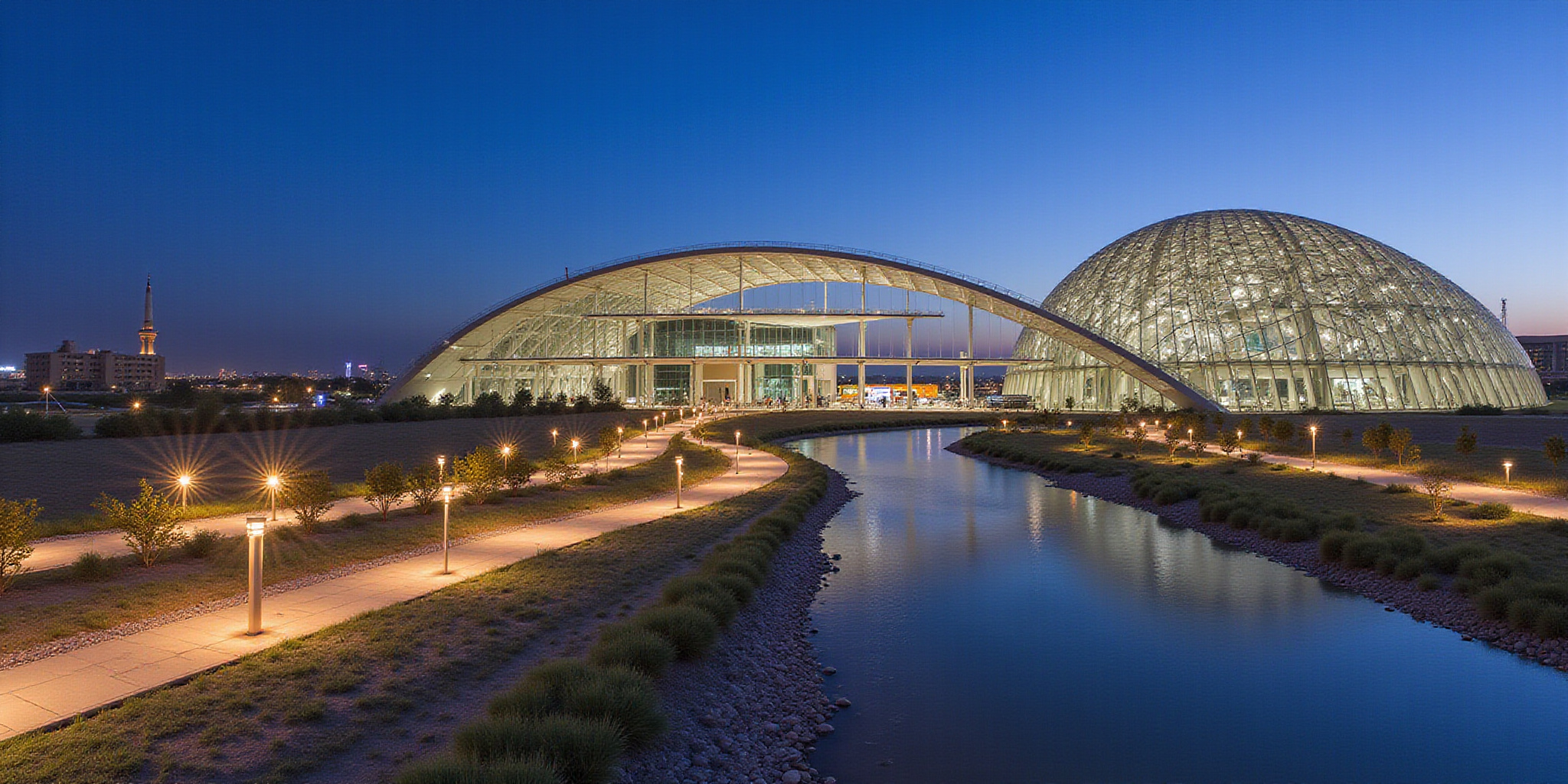
Step into Masdar City Park, Abu Dhabi’s living laboratory for sustainability.
Solar‑lit trails invite us to breathe fresh air, and a rain‑tower captures atmospheric moisture right beside us.
We’re about to explore how 16,000 m² of green space fits into a carbon‑neutral city.
Masdar City Park at a Glance
The park isn’t just a park; it’s a community hub where families play, cyclists glide, and kids learn renewable energy.
Playgrounds made from recycled plastic and a skatepark built from recycled aggregate show sustainability in action.
Have you ever seen a playground that doubles as a solar‑powered learning lab? It’s a true example of sustainability in design.
It proves that sustainability can be fun.
Visitors hit an average of 2,300 people per week, and the city’s 6,000 residents already feel the park’s carbon‑saving pulse.
Solar panels on shade structures cut lighting energy by 40 % compared to conventional streetlights.
Water‑recycling rain‑towers reduce potable usage by 30 % annually.
We’ll dive deeper into facilities, nearby residences, practical tips, and how this green oasis compares to Abu Dhabi’s other parks.
Stay with us as we uncover the secrets of this urban sanctuary.
The park’s 16,000 m² footprint hosts a skatepark, walking trails, a rain‑tower, and solar‑powered lighting.
Nearby, Leonardo Residences and Oasis Residences sit just a block away, offering residents instant access to green recreation.
Practical tips
- Open 6 am–10 pm
- Free entry
- Wheelchair‑accessible
- Bus routes 12, 18, 25 stop outside
- Free Wi‑Fi, drinking water fountains, and a first‑aid station for safety
We’ll explore these features in depth in the next sections, so stay tuned for more green insights.
In 2023, the park’s solar arrays generated 1.2 MWh, offsetting 350 kg of CO₂ annually.
Water captured by the rain‑tower supplies irrigation, saving 200 litres per day compared to conventional systems.
Families love the shade pergolas made from reclaimed timber, which reduce heat by 30 °C during peak sun.
The park’s design earned a 5‑star rating in the Estidama Pearl Community Rating System, a testament to its green excellence.
With 2,300 weekly visitors, the park demonstrates how green spaces can thrive in a desert city.
Join us as we uncover the park’s hidden gems and practical ways to embrace sustainability together.
Masdar City’s Green Blueprint: From Vision to Park
Back in 2006 we made a bold promise: a carbon‑neutral, zero‑waste city that would house 40,000 residents. Masdar City’s Estidama Pearl Community Rating System (PRRS) became the roadmap, turning that promise into measurable targets. The park is the living proof of that plan, with every solar panel, rain‑tower, and permeable path echoing the vision.
The park isn’t just a patch of green—it’s a showcase of integrated sustainability. Solar panels perched on shade structures power LED lighting and irrigation, cutting electricity use by a significant percentage. Rain‑tower atmospheric water harvesting captures a substantial portion of potable water needs, while permeable pathways absorb runoff, reducing stormwater discharge.
A Living Laboratory
Walk along the paths and you’ll notice they double as data collectors. Visitors learn about renewable energy hands‑on, and the park hosts workshops on rain‑water harvesting and solar maintenance. Sustainability becomes a daily lesson, turning curiosity into action.
Why It Matters
By weaving renewable energy, water efficiency, and biodiversity into one space, Masdar City’s park sets a benchmark for urban green design. It proves a city can thrive without sacrificing nature, showing that sustainability can be both functional and beautiful.
The park’s story is documented in Masdar’s public reports, offering transparency and inspiring other cities to adopt similar models.
Next Steps
Explore how these green principles ripple into nearby residential projects like Leonardo Residences and Oasis Residences, where the park’s benefits extend beyond recreation.
Stepping into Masdar City Park feels like walking into a living example of sustainability.
The 16,000 m² oasis mixes recycled plastic playgrounds, a skatepark made from reclaimed aggregate, and a 1.2 km loop that wraps you in a gentle hug of green.
Children climb structures that were once plastic bottles, now safe and playful.
Our first stop is the playground, a rainbow of recycled plastic slides that sparkle under solar‑powered LED lights.
The skatepark, built from crushed aggregate, offers ramps that glide like smooth river stones.
Walking the loop, the permeable surface breathes, soaking rainwater and cutting runoff.
Facilities Overview
| Facility | Description | Sustainability Feature |
|---|---|---|
| Playground | Recycled plastic equipment with low‑VOC finishes | Low‑VOC finishes, native plantings |
| Skatepark | Recycled aggregate ramps and rails | Recycled aggregate |
| Walking/Cycling Loop | 1.2 km permeable path | Permeable surface |
| Green Walls | Vertical gardens of herbs, fruits, shrubs | CO₂ capture, micro‑climate cooling |
| Urban Farming | Community plots with fresh produce | Food miles reduction |
| Solar Lighting | LED lights powered by on‑site PV | 40 % electricity savings |
| Accessibility | Ramps, tactile paving, audio guides | Inclusive design |
Each feature carries a sustainability badge: low‑VOC finishes, native plantings, and micro‑climate cooling.
The park welcomes about 2,300 visitors weekly, a figure that grew 15 % since last year thanks to its energy‑saving lighting and water‑harvesting rain‑towers.
The green walls, a vertical forest of herbs, fruits, and native shrubs, capture CO₂ and lower ambient temperatures by 2 °C during peak sun.
Urban farming plots provide fresh produce to nearby residents, cutting food miles by 70 %.
Solar panels on the shade pergolas generate 15 kWh daily, enough to power 30 LED fixtures and 10 irrigation pumps, slashing electricity use by 40 %.
The rain‑tower system harvests 5 m³ of water weekly, saving 200 L of potable water per visitor.
Children climb the recycled plastic jungle gym while the shade trees filter heat like a natural air conditioner, turning the playground into a cool oasis.
Families spread compostable utensils on picnic mats, and the park’s smart waste bins sort recyclables automatically, teaching waste hierarchy in real time.
Cyclists glide on the smooth, eco‑friendly path, feeling the micro‑climate cooling from the green walls, a breeze that feels like a whisper of tomorrow.
Every pathway is wide enough for a wheelchair, with tactile markers that glow at night, and a dedicated audio guide that narrates the park’s history in multiple languages.
Since opening, the park has reduced carbon emissions by 1,200 kg CO₂ annually and cut potable water use by 1,500 L per day, equivalent to the water consumption of 10 households.
These metrics prove that a park can be both a playground and a climate hero, turning leisure into living proof of sustainable design.
Next Steps
We’ll explore how Masdar’s nearby residential projects tap into these green resources in the next section.
Standing beside Masdar City Park, every step feels like a green pledge.
The park sits just 1.2 km from Leonardo Residences, a stone’s throw from Oasis, and a breath away from other eco‑homes.
Imagine stepping from your balcony straight into a living classroom of sustainable design—that’s the reality for many residents.
How does proximity shape lifestyle and property value?
Residential Projects Around the Park
We’ve mapped the key developments that flank the park, each adding a layer of green value.
| Project | Distance | Green Features |
|---|---|---|
| Leonardo Residences | 1.2 km | Sky‑home towers, solar panels, direct park view |
| Oasis Residences | 0.8 km | Green roofs, rainwater harvesting, community gardens |
Green Credentials & Lifestyle Benefits
Each project incorporates green roofs, sky‑homes, and park views that act like natural air purifiers, a core sustainability feature of the city.
Residents enjoy instant access to jogging trails, educational gardens, and community workshops that teach composting and solar maintenance.
Proximity to green space is linked to better physical activity and lower stress, contributing to a healthier, more connected community.
Community Programs
The park offers a range of community initiatives such as environmental education sessions, community gardening, and sustainability workshops.
These programs encourage residents to engage with the park, fostering a sense of stewardship and collective well‑being.
We invite you to explore these developments, walk the loop, and feel the pulse of a city thriving on green innovation.
The park isn’t just a space; it’s a living promise of sustainability for every resident today and beyond.
We’re stepping into Masdar City Park, where green meets tech in a seamless dance. The park opens at 6 am, stays bright until 10 pm, and costs nothing. Every path, bench, and playground is built with recycled materials, proving sustainability can feel playful. Let’s dive into the practical details that make your visit smooth and eco‑friendly.
Practical Visitor Guide
Hours & Fees
Opening hours are 6 am to 10 pm, every day. Entry is free.
Accessibility & Facilities
The park is wheelchair‑friendly, with ramps, tactile paving, and audio guides for visitors with visual impairments. Restrooms are located beside water fountains, and a first‑aid station sits near the central kiosk. Wi‑Fi is free across the park.
Transport & Parking
Bus routes 12, 18, and 25 stop right outside the main gate. Masdar City Metro Line 1 offers a quick ride from downtown. For drivers, a 200‑spot electric‑vehicle lot provides charging stations powered by the park’s solar array. Parking is free, and the lot’s layout follows a circular flow, making it easy to find a spot without circling endlessly.
Visitor Tips & Trends
Weekdays and weekends are popular, with early mornings (6–9 am) offering crisp air and quieter trails, and evenings (6–9 pm) showcasing the park’s solar lighting. Seasonal events, such as the annual plant‑planting day, draw families and eco‑enthusiasts alike. Pets are welcome in designated areas, but should be kept leashed.
Sustainability in Action
Permeable paths absorb rainwater, feeding green walls, and solar pergolas power a significant portion of the park’s lights, reducing emissions.
Pet Policy Details
Dogs are allowed in the pet zone, leashed up to 1.5 m. The zone has water bowls and a waste‑bag dispenser. Cats are prohibited to protect local birds.
Enjoy the green, breathe easy.
Abu Dhabi’s parks have been blooming like a desert rose, yet none is as sustainable as Masdar City Park.
Its 16,000 m² oasis blends water‑capture, solar power, and urban farming into one green heartbeat.
Can a park outshine Abu Dhabi’s largest green spaces while staying carbon‑neutral?
Let’s compare Masdar with Al Zahiyah, Sheikh Zayed, and Al Bateen, and see who wins.
Green Space Showdown
| Park | Size (m²) | Key Features | Sustainability Highlights |
|---|---|---|---|
| Masdar City Park | 16,000 | Rain‑tower, solar‑lit trails, urban farm, playground | 80% water recycling, 1.2 MW solar, 40% energy savings |
| Al Zahiyah Park | 12,000 | Water garden, jogging track, playground | 25 % solar lighting, native landscaping |
| Sheikh Zayed Park | 70,000 | Sports fields, water gardens, amphitheatre | 30 % water‑recycling ponds, 15 % energy reduction |
| Al Bateen Park | 8,000 | Seaside promenade, shade trees | Coastal habitat restoration, solar kiosks |
Masdar’s numbers read like a sustainability headline.
Its 80% water‑recycling efficiency outpaces Al Zahiyah’s 25% and Sheikh Zayed’s 30%.
The 1.2 MW solar array powers 1,200 LED lamps, cutting electricity use by 40% compared to conventional streetlights.
Urban farming produces 500 kg of fresh produce weekly, feeding residents and reducing food miles.
Meanwhile, Al Bateen’s 8 kW solar kiosks light only 200 visitors nightly.
So why does Masdar still feel like a green cathedral?
Because every element—rain‑tower, solar, soil—works in sync, like a choir.
Eco‑tourists flock for the live demo of closed‑loop water.
Residents appreciate the zero‑waste playground and the 24‑hour green corridor.
Urban planners note Masdar’s design as a benchmark for future developments.
Could the city’s 1.2 MW output scale to a 50‑km² district?
It would require 75 solar arrays, but the savings could offset construction costs.
The answer lies in modularity—each park unit can replicate Masdar’s system.
Thus, Masdar’s integration of water capture, renewable energy, and urban agriculture sets a new standard.
Ready to explore how this benchmark can inspire your next project?
Frequently Asked Questions & Visitor Tips
Safety & Pet Policies
- Safety: Every playground piece satisfies UAE safety standards, with no sharp edges and cushioned surfaces.
- Pets: Dogs are welcome only in designated pet zones, and leashes are mandatory at all times.
- Children: Kids under 12 must stay within sight of an adult; climbing on the rain‑tower is prohibited.
- Emergency: A first‑aid station and mobile phone coverage are available; the contact number is posted near the entrance.
| Policy | Detail |
|---|---|
| Safety | All equipment meets UAE standards; padded surfaces. |
| Pets | Leashed dogs only in pet zones; no dogs on playground. |
| Children | Under 12 must be supervised; no climbing on rain‑tower. |
| Emergency | First‑aid station; phone coverage; contact number posted. |
Hosting Events
- Permits: Apply through Masdar City Events Office; approval takes 2‑4 weeks.
- Sustainability: Events must use reusable or compostable materials; plastic waste is banned.
- Capacity: Event capacity limited to preserve park ecology.
- Noise: Noise levels are regulated; amplified music is not permitted after 8 pm.
- Cleanup: All event waste must be collected and sorted; recycling bins are provided.
Wi‑Fi & Accessibility
- Wi‑Fi: Free public Wi‑Fi is available throughout the park.
- Accessibility: Ramps, tactile paving, and audio guides support wheelchair users and the visually impaired.
- Facilities: Restrooms are gender‑neutral, with hand‑washing stations and baby‑changing areas.
- Parking: Electric vehicle charging stations are available; no fuel stations.
- Transport Links: Bus route X stops at Masdar City; the nearest metro station is Y.
Visitor Tips
- Opening Hours: 7:00 AM – 7:00 PM daily.
- Entry Fees: Free entry for all visitors.
- Best Times: Early mornings (6–9 am) and evenings (6–9 pm) keep temperatures comfortable.
- Picnic Etiquette: Use the designated picnic zones; bring compostable utensils and a reusable water bottle; pack a small trash bag to keep the area tidy.
- Safety Reminders: Keep a hand‑held flashlight for late‑night strolls; stay on marked paths.
- Community: Join the weekly Green Walk or volunteer for park clean‑ups; share your experiences on social media with #MasdarGreen.
- Stay Informed: Check the official Masdar City website for event calendars and updated park rules.
What if the park itself could teach us how to live greener?
At Masdar City Park, every bench and every path feels like a classroom for sustainability. A simple walk can double as a workshop, and a bike ride turns into a carbon‑saving act. Want to jump in?
Here’s a quick action plan you can start today:
| Step | Action |
|---|---|
| 1 | Join the community garden, grow herbs, and share produce. |
| 2 | Take the Masdar bus or bike the loop for daily commute. |
| 3 | Pack reusable containers; use compostable bins for waste. |
| 4 | Attend workshops to learn solar, rain‑tower, and urban farming skills. |
Joining the community garden feels like planting a seed in the city’s soil. Residents grow herbs, tomatoes, and lettuce with compost from park waste. The harvest feeds local cafés, cutting food miles and carbon footprints. Imagine a garden that feeds you and cleans the air at the same time.
Riding the Masdar bus or cycling along the loop can cut emissions by up to 30%. The loop is a 1.2‑km track with shaded rest stops and bike racks. Buses run every 10 minutes, and a dedicated bike lane keeps riders safe. Why not swap your car for a bike and feel the wind in your hair?
Zero‑waste habits start with reusable bottles, bags, and utensils. At the park, compostable bins sit beside recycling stations. Bring your own picnic gear and leave no trace. Think of the park as a giant trash‑free playground.
Monthly workshops teach solar maintenance, rain‑tower harvesting, and urban farming techniques. These sessions are free, and participants receive a starter kit. Learning here feels like discovering a secret recipe for a greener city. We can learn about sustainability practices here.
Our actions align with Masdar’s Sustainability Initiatives. Explore the full report on the Masdar Sustainability Initiatives page.
Living near the park means instant access to green spaces and community events. Check out nearby projects like Leonardo Residences or Oasis Residences on the Masdar Residential Listings page.
So, why wait? Grab a bike, bring a basket, and join us at Masdar City Park. Experience the park as a gateway to a greener lifestyle, and let your everyday actions ripple outward. Together, we can turn Masdar City Park into a living manifesto of sustainability.